Tuesday, 26 August 2014


Welcome to the featured poet series at SLASH! In this series, we interview spoken word artists of any age, any background, from anywhere in the world. We feature established poets alongside students and writers who are just beginning to hone their spoken word skills. Read on to learn about a brilliant writer and member of the HASH staff, Ariel Chu!


photograph by Sam Jeong
Name: Ariel Chu
Age: 18
Location: Eastvale, California


1. How did you first get involved with spoken word?


Though I've loved poetry since elementary school, I didn't get involved in spoken word until  college. A confluence of forces helped me to fall in love with the medium: my involvement in theatre, an impulsive decision to join my school's spoken word club, and the fortune of meeting other writers who had experience in the field. Before then, my only exposure to spoken word was through YouTube videos and the occasional high school poetry slam. It took me a while to realize that I could be an active participant!


2. What themes commonly feature in your poetry? How do you use the medium to express identity?

Poetry is a place of heightened emotion for me, a medium where the feelings I internalize around others finds a sort of cathartic expression. As a result, the subjects I end up writing about are dramatic to the point of being somewhat overwrought. There's the typical young adult angst--love, insecurity, idolizing people who are irresistibly toxic. But spoken word also provides an ideal platform for talking about problematic issues and making them resonate with an audience, and I've recently found that it's a great outlet for talking about my identity. As an Asian-American woman, I've faced no shortage of doubt about my ability to write well, engage in creative work, and succeed in the performing arts. I've grown to use spoken word as a platform not only for sorting through emotions, but also for addressing and dispelling some misconceptions about who I am. As a result, my work has turned a bit more political lately, dealing with the barriers that I've had to overcome as someone who doesn't fit the preconceived notion of who a "writer" should be.


3. How would you describe your style?

Having been involved in both writing and theatre, I love that spoken word is a chance to merge the best of those two mediums. Most of the poetry I write follows a rhyme scheme, and spoken word is an ideal platform for conveying the sense of rhythm, momentum, and musicality I enjoy. I'm also working on bringing elements of theatricality and storytelling to my performance--time will tell how that works out! Overall, I'd like to say that my works have a sense of flow and rhythm to them, a kind of sing-songiness that delivers unexpected, emphatic punches.


4. What sets spoken word apart from other forms of writing and performance?

Writing and most performing arts seem to hold the audience at an arm's length--authors speak to their readers only through words on a page, while actors and dancers have to exist in a world apart from the people watching them. But spoken word doesn't shy away from human interaction so much as it thrives off of the dialogue between the poet and the audience. A poem becomes a conversation, and a performance becomes inclusive. It's a much more personal and vulnerable form of art.


5. What inspires you?

I'm inspired by passionate emotions, thought-provoking conversations, social justice, powerful people, and larger-than-life beauty. I'm particularly enamored by the romance of deep space, the sea, and the desert.


6. Who are your favorite spoken word artists?

I've recently discovered a fondness for Franny Choi--"Floating, Brilliant, Gone" is beautiful both when read and performed. I admit to being new to the larger spoken word scene, though, so I've yet to discover a definite favorite.


7. Anything else you'd like to share about your experience? Any advice?

Don't allow others to stifle your inspiration or discourage you from your ambitions--if you can't believe in your own work, there's no reason to expect that anyone else should. Instead, use the doubt of others as fuel for your dreams. Success is the greatest revenge, and your persistence can inspire an entire slew of young poets who are in a similar place of self-doubt.


AMERICAN INVENTION by Ariel Chu

My name is Ariel.

I'm a tiny, fragile thing. My skin reeks of the color
Of anemic, washed-out sunshine. My roots are LA,
but still they ask me, "You're from China?" So I turn to them and say
That I am, and always will be, an American invention.

I spent most of my childhood adhering to convention.
When they value you for perfect grades and give you vast attention
Just for being nice and quiet and a paragon of silence
Then you learn to shut your mouth and give up all creative license
So they like you.

Yes, my mom said "people like you
Don't get work published in bookstores; no, your last name is abrasive
And the media erases
all the people with our faces
There are never special cases when it comes to people like you."

And I wondered if she's right, too.
Since I've always had to fight to
Justify my need to write to
Almost everyone I meet.

But I'm no precious fortune cookie:
Yellow and brittle, harmless and little
Break open the middle and read what you like
Protract all my sweat while you retract my rights.

And I'm not a dead white man
And I am not your Amy Tan
And I am not the robot chemist mathematician people think I am.

My name is Ariel.

My claim to creativity is no point of contention.
That is, and always will be, an American invention.


[audio coming soon]


Abigail Rampone, SLASH Columnist
slashcolumn@gmail.com

Thursday, 21 August 2014

I apologize for SLASH's hiatus over the past month - my residency at the campus environmental center unfortunately interfered with this column's upkeep. I hope that all of HASH/SLASH's readers have had an eventful and productive month! Additionally, I wish a productive and literary (!) school year to all students who are preparing to return to the classroom.

Here's what you can expect from SLASH as the column resumes its weekly schedule:

  • Next week, look for an interview with another member of HASH staff who experiments with the spoken word!
  • The following week, SLASH will present a piece about spoken word and activism. Stay tuned!
  • SLASH has established a tumblr presence to reach out to spoken word artists throughout the web. Check us out and follow us here!
And as always, please email me with questions/feature suggestions/etc. SLASH is a work in progress and I'd love to hear from you.


Abigail Rampone, SLASH Columnist
slashcolumn@gmail.com
Tuesday, 29 July 2014

We can’t be friends. We’ve been spoken for by the Universe, a power so knowing, so undeniable - it is beyond our combined scope. We can spend days by the ocean, skipping stones and flicking cigarettes but we know separation like we know regret; how inevitable it is, how looming it is.

The wind blows, a wave crashes and I turn to you, your body rich in color, irises the shade of emeralds, hair in a messy ponytail; a vibe so unfamiliar. I remember when I couldn’t look away.

“What do you think happens when we die?”

Sunlight hits your lens yet I can still see myself in the reflection, an orange tinge of a human being.

“Poof,” you say. “Nothing. You live and you die.” Your delicate fingers dance in the wind, hands intertwined above your head.

But that’s not true. You don’t believe that. We used to ditch parties and go to rooftops and stare at stars and point at the ones we’d like to come back as. I don’t faze you, you’ve grown too accustomed to these type of questions and musings.

“I feel sorry for you if you really think that,” I say and lay out, let the Sun scorch my skin, the beach towel the only thing between my bare back and specks of sand.

“Were you planning on doing something? You should do it soon.”

~

If I left it to you to explain, our story has no magic. It’s a moment. We met in a library, you needed a pencil, whatever. But when you hear me talk about the moment our eyes aligned, I can sense your awe, your sight following the words into the air, wishing you could gather this language and store it into a cauldron or a vase, decorate it with flowers, show it to your children. This fool fell for me one day. And he fell for me hard. Look how much he cared about me. Look at all the nice things he said about me.

“Our love is a facade,” you told me in privacy, two years later, cigarette in hand, eyes distant, cold, not there.

“A facade?”

“It’s not real. Nothing is real. We’re not here to do this, to live like this.”

“I love you.”

“How can you be so sure? What gives you the right to say something like that?”

“Just sit, let’s talk, can we talk?”

“I have to go.”

~

Why does the Woman cry? Why does the Man shout? If you leave, I’ll fall apart. I’ll disintegrate into the Earth, a lost memory, a facade of a human being, irrevocably ruined.

“I can’t do it anymore, I can’t take this shit.”

Your silhouette in the sun astonishes me. Its slender form, the way it moves, so smooth, so temporary. You know the type, the type of tears that sting to wipe away, to burn to release. If you leave, I’ll smoke a million cigarettes, drown in alcohol, call my mother, stare at space. We can’t be friends because we listened to Empathy together too many times in my backseat, in your bed, in my bed, in this lifetime. “I love you in a place where there’s no space or time.”

Sitting down next to me, your long fingers sifting through the sand, lighting a joint, I don’t think I could ever love again.

“This isn’t working. You’ve got to let me go, you’ve got to let me live.”

I could never be a surgeon. My hand trembles at your diction alone, my heart spirals into delusion. If you leave, I’ll go for a drive with the windows down, let the wind hit me. You always told me to remain unassuming, uncertain of the future. It’s a dice roll, a flip of a coin. It’s torturous. There's no year... just seasons.

"You need to love yourself first.”

I always knew it, I always knew love shouldn’t end in exhaustion, in repetition. If you leave, I won’t leave the house, tormented by what-ifs, goodbyes and no mores.

“If I leave, will you be okay?”

You don’t wait for an answer. You stand, your shadow towering over me, joint dangling from your fingertips and keep walking, seemingly into the Sun as it sets, a lone figure, a soul departed, a love unrequited. We can’t be friends because our love manifests itself into a ghost, a hazy dream, an illusion. As I go my way, the assumed truth slowly dawns on me: however long the heart beats, it has beaten both for and by you.

Mustafa Abubaker is a 21 year old writer and student of Pakistani descent in Atlanta, Georgia. A self-proclaimed music-addict, he wrote this story inspired by a Dream Koala song of the same name. 

He says, "This story is for me. I want to look back at it years from now and feel something."


Monday, 21 July 2014

What if you could step into the shoes of one of your most beloved icons at one of those crucial moments in their lives that end up defining them forever? Adam Ashraf braves these murky waters, venturing into the mind of the eternally fascinating Truman Capote on the eve of one such moment... 

My publisher just hand-delivered a copy of my new novel that will hit the racks next week- In Cold Blood, by Truman Capote. Me – cold-blooded killer. Merely looking at the instrument I used for the murder – the murder of a man far better than I – makes me nauseous. I can’t bring myself to touch it, much less read it. I steal a look at the back cover and read, “On November 15, 1959, in the small town of Holcomb, Kansas, four members of the Clutter family were savagely murdered by blasts from a shotgun held a few inches from their faces. There was no apparent motive for the crime, and there were almost no clues. As Truman Capote reconstructs the murder and the investigation that led to the capture, trial, and execution of the killers, he generates both mesmerizing suspense and astonishing empathy. In Cold Blood is a work that transcends its moment, yielding poignant insights into the nature of American violence.”

Truman Capote. My name always comes with a little bio. In early days, I was called “Local Reporter”. Later, it was “Freelance Writer for The New Yorker”. “Best-selling Author of Breakfast at Tiffany’s” followed. Today, I get a new sobriquet. It is the most significant of them all.

I wrote a book that was of a new genre; a new style of writing. It is bound to become a classic and is probably going to be compared to the work of Hemingway. I am probably going to be put in the league of Dickens, Twain and Fitzgerald. I’m not just about to become the Manhattan literary toast of the sixties, I am about to become an icon. As the dreariest of thoughts pops into my head, I pour myself a glass of champagne and toast, “To the man who betrayed his friend!”

“Was it all worth it?” I wonder. In forty years, what will the world remember? The man who betrayed his friend or the man who wrote the best non-fiction novel of his generation? Am I going to be compared to Hitler or Lincoln? After draining my glass down in a single gulp, attempting to vanquish the guilt that refuses to let me go, I pour another drink. “To the man who will inspire writers in generations to come”, I say as I wait for my emotions to numb.
(continued below)

“Of course it was worth it!” the rational side of me attempts to calm it down- the guilt.

“They were murderers, Truman.” I remember, my best friend, Nelle Harper Lee’s words from right after the execution. They are words that never fail to calm me down. “They were murderers, Truman”, I repeat to myself. Those words are my calming lullaby. They soothe me and shelter me from my own self-contempt. They help me sleep at night. I slump into slumber praying that they will sink in once and for all even though I know they never will. They are laws. They are not the spirit of the laws. They are what bound the laws, but they had nothing to do with justice. They are not what bound me. I know better. Perry Smith was indeed a murderer, but he was no beast. Perry Smith was indeed a murderer, but he was no monster. Smith was my friend. If Smith was a monster, then who is not?! If Smith was a monster, then what am I?! And now he is gone. The pen is mightier than the sword. I would know - I used it to kill.

That champagne isn’t serving its purpose. I need something stronger. I gulp a gin martini and toast out-loud with the theatrical tendencies I shall forever be notorious for, “TO THE MAN WHO KILLED HIS FRIEND”. I scream hoping it will numb my senses because the alcohol is doing such a bad job.

My demons will haunt me for life. I know that. I know that my editor, Shawn, is a stranger to the truth. He will lie to save himself the guilt. “You didn’t kill them,” he would tell me with the most plastic of smiles on his face. “You simply did not help.” Nothing is further from the truth. The whole jury probably read In Cold Blood’s excerpts before the final verdict was made and the sentence was uttered. I practically tied the noose around Smith’s neck with my bare, filthy hands, to land myself a bestseller. No, no, no – I did it to make myself an icon. I need more gin. Straight, this time.

“To the biggest writer of the twentieth century! TO THE BIGGEST FRAUD OF THE TWENTIETH CENTURY!” I toast in my sharp voice as I turn around flamboyantly.

What is happening to me? Why am I thinking like that? This is the book that millions around the world are waiting for! Millions around the world are chanting my name! I can’t pull the plug now. It’s too late. I’ll open a charity in Smith’s name. It’ll be redemption for his sins. “And yours too,” my demons remind me with a condescending look on their faces. I don’t know what they’re talking about – I haven’t done anything wrong. Everything will be okay. In one week, I’ll be the biggest household name in New York. I’ll be the biggest household name in America! I’ll attend all the fabulous galas and parties. Life will be good. It will be good. I’m sure it will be.

“It ought to be, right?” I mutter over another glass of gin.

-Adam Ashraf

Thursday, 10 July 2014

Hello, spoken word poets! Here’s SLASH’s very first spoken word prompt. In the coming weeks, you’ll see more in-depth features about identity, activism, and spoken word. For now, I’d like to offer a quick prompt to make you think about how you can use the medium. SLASH is an educational column and it should be a conversation among readers and performers, so I want to see what you can do.

Spoken word’s immediacy and vitality allow spoken word artists to make very personal performances. It’s essentially storytelling and storytelling can be a very effective form of activism. It might not initiate widespread policy changes, but it affects individuals. To change one person’s mind feels very concrete and genuine. You can do that by telling your story. That story doesn’t have to be the sum of your entire life, though. Moments are just as important.

When you tell your story, you can draw the reader in with intense concrete imagery. For example, sentiments like “love conquers all” or “do unto others as you would have them do unto you” may be shared among many people, but we’ve all heard it before! Those lines are dry with overuse. When you use specific examples to make a universal emotion feel nitty gritty and personal, you remind your reader that the idea is still real. It isn’t lofty or romanticized - it belongs to a real person! Your story has unique details. It may involve emotions that many people feel, but it’s something they’ve never quite heard before.

So! Here’s the challenge:

1. Pick a moment from your life that you associate with a specific emotion.

2. Make a list of concrete images to describe that moment. What did you smell? Taste? Feel? Hear? I want salt, strangely tinged skies, strawberry juice, dirt, the sound of firecrackers, or sun shining on glass. 

3. Write a poem of images that make up that very specific moment. Convey emotion without ever using “feeling” words (no “happy,” “sad,” “angry,” etc).


4. Read it aloud. How does it feel? Which words stand out? Which words do you stumble over? Practice emphasizing different lines. 

5. If you’d like, make a recording of your moment poem. Send it to SLASH to be featured in the coming weeks!

Here’s my example:

1. Moment: the Fourth of July parade in my hometown after a storm. Emotion: nostalgia/sadness.

2. Images: children playing in mud puddles, chilly, muddy gravel, cars going the wrong way, a six-legged dragon, overcast sky, hot sugar, gray boards, white T-shirts, children singing, my uncle clapping, dirty flipflops, horns blaring...

3. Write:

children splash in mud puddles in the road,
throw rocks at the holes in the cement.
cars turn around and drive where they shouldn’t go.
today the dragon is coming, the dragon is coming
down from the cloudy sky.
the horns are out of tune.
children sing. my uncle jumps up and down.
yesterday, the hurricane ripped through again
and knocked the trees on rooftops,
flooded the lakes out into town,
piled the power lines like spaghetti.
the dragon is coming from the sky
into the gray morning.
he chases the rain down the road,
brings back the heat.


4. Record (sound or video!):


As always, please email me with questions/feature suggestions/etc. SLASH is a work in progress and I’d love to hear from you.


Abigail Rampone, SLASH Columnist
slashcolumn@gmail.com

Friday, 4 July 2014

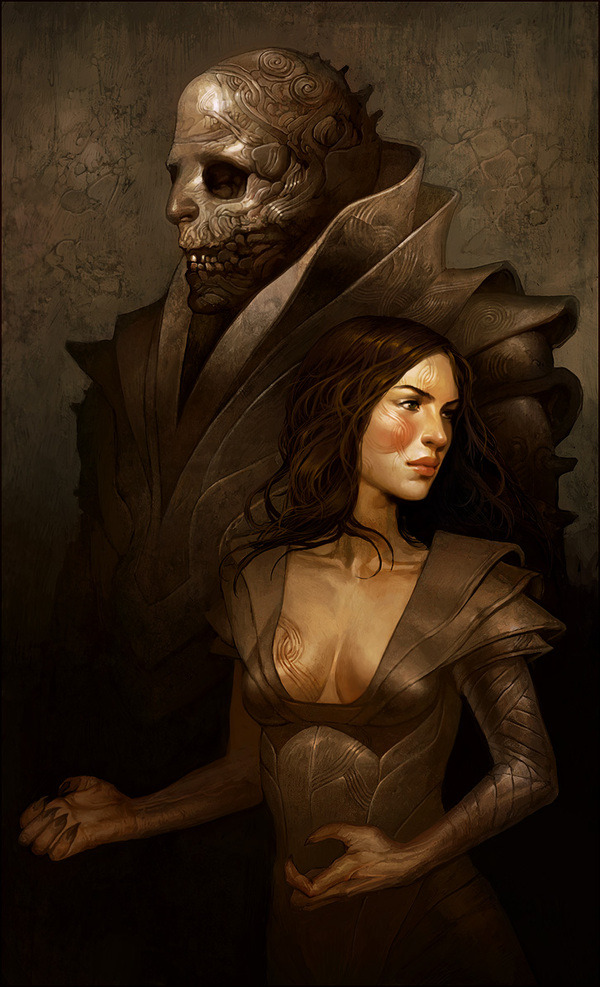
Digital painting by Falk
Is this a common courtesy,
Alive in only me? 
Where once it was that thriving pulse in every vain, 
A common place, 
But with a societal pace, 
So easily did die away? 

Red, 
And rose, 
And chose- 
To leave a door unopened, 
A chair pulled in, 
A glass of wine replaced with rum, 
And beer, 
And sunsets of a fruity tinge? 

Or so did we whisk away- 
With a rude, 
Crude, 
Brute replace- 
Chivalry.

But try it for a taste, 
Give it your hand, 
For a kiss to place. 
You’ll find no kinder smile, 
Nor gentler pace. 

A suit, 
A tie, 
A poem- 
Confession? 
A lie… 

Oh but isn’t that the trouble, 
Let Chivalry that died rest,
It did so because- 
And this one must detest so- 
A fib, 
A phrase, 
A passing phase- 
I grieve, 
I weep, 
Because Chivalry did so, 
For Chivalry’s sake.

-Maurina Robinson
An aspiring Lead Game Designer, who captures dreams in writing as inspiration for that truly iconic, "terrifying" and artistic game that many will hopefully enjoy.

Read Maurina's "Butcher" in Issue 04 here.

Wednesday, 25 June 2014

Welcome to the featured poet series at the SLASH spoken word column! In this series, we will interview spoken word artists of any age, any background, from anywhere in the world. We feature established performers alongside students and writers who are just beginning to hone their spoken word skills. Read on to learn about our first featured poet, Zoë Riell!

Name: Zoë Riell
Age: 17
Location: Poultney, VT, USA


1. How did you first get involved with spoken word?

I was introduced to spoken word poetry in the first Creative Writing class I participated in - before that, I had dabbled with it briefly, but it wasn't until I was given an assignment to write something for the specific purpose of being read aloud that I really started to delve into it with any kind of seriousness.


2. What themes commonly feature in your poetry? How do you use the medium to express identity?

Lately I've noticed that many of my recent poems have featured the longing for fantasy - the desire for the un-ordinary and un-real in everyday life, and how that affects how someone sees the world. More often than not, I'll have a 'protagonist,' if you will, within my poems who, somehow or other, begins a metaphorical journey to go beyond the three dimensions and see what else is out there. In that respect, I guess you could say that my poems are deeply rooted in curiosity. The one thing about spoken word that I can appreciate for personal purposes is how open it is to emotion - the line break, the carefully-placed punctuation, the specific inflection of just one word when read aloud - each of those factors is paramount to being able to express what I want to say in the method I want to convey it.


3. How would you describe your style?

I would describe my style as surrealist - I enjoy taking my readers and listeners to places where they may not feel comfortable or at home, while still maintaining that human element as a lifeline that keeps them invested in the piece.


4. What sets spoken word apart from other forms of writing and performance?

Because it is so vast a medium! With spoken word poetry there is no right or wrong way to go about it - you might write it with blunt vocabulary, leaving nothing to the imagination, or you could shroud your piece in mystery and leave the readers and listeners guessing. The spoken part lends a lot of aid to both sides - there is nothing like hearing something read aloud by the author - it's a glimpse into how they see it, what they were thinking when they wrote it, what the poem means to them. That's why I will always return to spoken word again and again and again.


5. What inspires you?

Reading, without a doubt. I tend to gravitate towards surreal, metaphorically dense & poetically written fiction, and generally speaking if I find one I enjoy very much, at least four or five poems will come of the experience I had while reading them. Also, too, various media forms have all inspired me at one point or another - I've had poems I'm proud of stem from TV shows, from movies, from video games, from a verse in a song. I'm very open to inspiration coming from all sorts of sources.


6. Who are your favorite poets or spoken word artists?

I've have to say Donald Hall - I was given a chapbook by him by my Creative Writing teacher because she thought I might find a connection within his work, and I'm very grateful she did. He has a specific style in which to the casual eye he is merely narrating the everyday, but underneath he manages to capture intense, complex emotions and experiences. It's a feat I've always envied, and I've devoured his work in the hopes of figuring out just what makes him tick.


7. Anything else you'd like to share about your experience? Any advice?

Just write! I'm a notorious perfectionist, and so I find myself making excuses not to sit down and write everyday because I don't have proper inspiration, because it'll be shit, because it'll only be a line and it'll waste paper, etc etc. But what I'm trying to beat into my brain right now is that even if the first draft of something scribbled on the fly is something that should never see the light of day, it will still sit in the back of your brain the next time you sit down - maybe that line break that was decent, those two words you liked, the title you thought was clever, will inspire you to write something glorious the next time!


No Glass by Zoë Riell 

There’s no room for glass in here –
only the labeled shears to shorten
the ribs, the bellows
for the cavernous lungs, and the towering
dumbbells larger than I that I
attempt
to lift sometimes.
No room, not ever,
lest the blood be drawn
out from the woodwork.
I have welded the hinges to the muscle
of the mind—
no doors to my home, no welcome
mats spread for you.
I live with mementos,
memories, meticulous
mindsets,
but no glass.
No glass in here.


Abigail Rampone, SLASH Columnist
slashcolumn@gmail.com