Showing posts with label Hash Nation. Show all posts

Friday, 13 February 2015

                                                                  In my enthusiasms pages
                                                                  turn thick
                                                                  with ever-more-ecstatic markings. 
                                                                  He said
                                                                  no one can ever read a book 
                                                                  I've read.
                                                                  My hieroglyphics serve me well,
                                                                  though,
                                                                  and I hate the paltry margins
                                                                  of Kindle.
                                                                  More like you, they are, lost
                                                                  in the past,
                                                                  words raced by and gone back
                                                                  into mystery
                                                                  of thoughts come and gone into ether.
                                                                  My treasures
                                                                  require much pumping up to stay,
                                                                  fireworks
                                                                  on a darkened winter sky.


Carol Hamilton is a retired educator, having taught elementary school in Connecticut, Indiana and Oklahoma, community college and in the graduate writing program at the University of Central Oklahoma. She has published 16 books of poetry, legends, and children's novels.

Friday, 6 February 2015

           Today he was pacing back and forth, dragging his fingers in the dirt and glancing at the people.

           Last year, he'd sat there like a stuffed trophy.

           Jim, John and I yelled and threw peanuts, a handful of which sold for a nickel from a glass dispenser by the guardrails. When some of the nuts hit him, he picked them up one by one with a hand way too big for the job, but then he delicately picked off the shell with his fingertips, popped the nuts in his mouth, and ate them. Just like we'd do. John, Jim and I laughed real loud.

The gorilla looked at us, stood straight up, roared, and beat his chest with his hands, Whap! Whap! Whap!

           It scared me and all three of us jumped back. A man in a blue uniform with 'Cincinnati Zoo' embossed on a white badge came over. "Don't tease him, boys. He's an old man like me, a silverback.Have a little respect."

           King Tut snorted and opened his mouth so his gums showed. His teeth were yellowish and worn except for four big fang-like canines.

           Jim said, "I'm glad he can't get out."

           My brother John and I stared down into the gulf that separated us from the gorillas. A moat they called it, but it didn't seem nearly deep enough to me. I glanced at the ape again, but he was ambling away, showing his rear end to us.

           "Let's go somewhere else," I said, still shaking.

           Mom said like a joke, "He's your cousin. So are all the monkeys. You're related to them."

           Although I'd heard that before, it stuck in my mind this time.

           The rest of the visit was just entertaining, like we were watching cartoons on TV: the animals brought up close enough to see clearly. The floppy proboscis drooped over the muzzle. The huge claws of the aardvark. The big-eyed nocturnals, tricked into feeding by some kind of special light in a dark room. Animals so enormous they were hard to believe. Roar, hiss and howl of their calls. They were odd and interesting, but they seemed very different from us. They lacked something King Tut had.

           He looked so much like us, he bothered me. Our hair was like his thick fur. His long fingernails were like ours only bigger and stronger. His roar had seemed like a human scream of protest or complaint. All he could do was howl and act up. We could use words. Knowing he was kept in a cage made me think that a wildness like his was locked up inside of ourselves, and we were just as afraid to let it out as the zoo keepers were to let King Tut run loose.

Bill Vernon served in the United States Marine Corps, studied English literature, then taught it. Writing is his therapy, along with exercising outdoors and doing international folkdances. His poems, stories and nonfiction have appeared in a variety of magazines and anthologies, and Five Star Mysteries published his novel Old Town in 2005.

Friday, 30 January 2015


one day the ground crumbles
the streets of stability split and

separate you
and me
and we stand at different poles
not tethered by power lines or sewage pipes and i feel
alone
despite the enormous sea
the enormous city engulfing me
and i wonder what the weather’s like on your side
and i wonder what i’m missing out on because i crossed over
and crossed back to what i once left behind
where are you? where are we?
across, over, around the bend?
lefts and rights that don’t lead to ends
lefts and rights that lead to nothing
they lead to nothing
nothing


Melani Grace Tiongson is a twenty-something Filipino-American writer based in New York. Although her aspirations lie in law and philanthropy, Melani has loved writing from a young age, and looks forward to seeing how her career goals will shape her future works.

Friday, 23 January 2015

A tolerant democracy 
allows self-full, bloated poets 
to hide in a university 
sneering at the workings of the world,
secure in the protective cloak of tenure.
Once poets' voices raised the call 
for freedom, other great causes.
Now most wallow in comforts 
mumbling impotent objections 
to current events 
beyond their comprehension.


- Gary Beck
Tennis-playing, ditch-digging, salvage-diving writer with a penchant for poetry. Explore his impressive repetoire of poems, short stories, novels, plays, and other musings at garycbeck.com

Tuesday, 30 September 2014

by Alan Swyer

“When are we going to have lunch?” Nadia asks for the third time in the last ten minutes.
“We'll be leaving for dinner right away,” my father replies as he's done twice before, his patience clearly wearing thin.

We're seated in the living room of their apartment in Boynton Beach, Florida, a nicely decorated place that only mildly suggests that it's part of an assisted living facility.
“Why won't you let me have lunch?” Nadia pleads a moment later, her face showing signs of confusion rather than hunger.

I like Nadia.  Though technically my stepmother,  I've always preferred to think of her as my father's second wife, given that I was already married and had two kids at the time I was Best Man at their wedding.  But now I'm witnessing for the first time what my father never quite managed to explain during our cross-country calls.  The woman he's living with, with whom he has shared what have been- without a doubt- the happiest years of his life, is barely the same one he married.

Nadia's decline, I'll come to understand as I get more information, began with the death of her son, whose attempt to be three different people at once -- a biker, a hipster, and an attorney -- ended tragically, with a fatal overdose.  That was a shock from which Nadia never fully recovered, and it was followed by a bad fall, which further accelerated her departure from reality.

The result, I see all too clearly, is a situation with little chance of improving.  The good times together are now consigned to my father's past in the same way as the misery he endured with my mother.


During my childhood, my father and I were never close.  He worked ridiculous hours in an ongoing attempt to satisfy a woman for whom satisfaction was impossible, then distanced himself even further from family life because of migraines that disappeared only once he was widowed.  When prodded into some facsimile of what my mother called manliness due to what she constantly termed my “impossible behavior”, my father would occasionally threaten physical violence, which failed to induce fear or obedience, especially once I'd discovered boxing.  At that point, after daring him to try what he called “getting tough”, the threats changed from hollow to nonexistent.

Yet despite the distance and differences between us, what I've come to realize is that, in a curious way, I started follow his example early on.  Like him, I did everything imaginable to stay out of the house as much as possible, then I topped him by running away on more than one occasion.

When, at the age of seventeen, I departed for good, my parents, too, relocated.  That led to a joke they never appreciated:  that their only mistake was in letting me get my hands on the new address.  But their move only reinforced my feeling of having no place to call home, since I knew no one in the Jersey suburb to which they moved, other than my mother, father, sister, and dog.  And only with the dog did I get along.


Though I have little interest in aphorisms, there's one that does apply to my mother:  “People don't change, they become more so.”  Never easy, she became, as the years went on, even more demanding, more difficult, and more impossible.  Thanks to a mental ledger she cherished of slights both real and imagined, over time she distanced herself from scores of friends and family members, diminishing not just her world, but my father's as well.

Not surprisingly, our relations were marked by periods of estrangement, which grew longer once I, having moved 3,000 miles away, was busy with a wife and kids of my own.   Even our sporadic ceasefires were short-lived, thanks to my mother's barbed criticisms of what she called “California child-rearing”, plus her one-sided comparisons between what she called my “poorly raised sons” and my sister's “little angels”.

When I got word, after a particularly lengthy period of silence, that my mother, a lifelong smoker, was hospitalized due to respiratory problems, I tried my best to put the past behind.  She was in Intensive Care by the time I got to Florida, fragile and frail, sustained only barely by an array of tubes and other devices. 

Putting on a smile as best I could, I entered her room with a bouquet of flowers, told her I was pleased to see her, and announced that I would try to round up other family members who, like her, had migrated south.  But when I mentioned one particular cousin from her generation, my mother grimaced. 

“What's the matter with Sylvia?” I asked.
“Everything!  She's a monster!” my mother sneered with as much force as she could muster.
“She's always been a sweetheart,” I replied.
“Shut up!” my mother snarled, her countenance radiating a kind of venom I hadn't seen in ages.
I studied her angry face for a moment, then left the room without another word.
“Why are you leaving?” I heard my father ask when he stepped into the hallway while I was headed toward the elevator.
“Want the truth?”
“Okay.”
“Because I want to remember her in character,” I explained. 
My father took a moment to let my words sink in.  Then, to my eternal surprise, he nodded knowingly.


That, to my surprise, was the beginning of a new and infinitely better relationship between my father and me.  With my sister caught up in her own private melodrama of mourning and grief, alternating crying fits with expeditions for spa treatments and new handbags, it was on me alone that my father relied.  I was the one entrusted with the task of making arrangements at a mortuary.  Then, once he made the decision to have the burial in Florida instead of in the family plot in New York, it became my job to find a cemetery.

And it was to me that my father expressed his dismay once everything was over and done with, wondering why so many women - some who were known to him, others total strangers - showed up at the funeral, bringing containers with coffee cakes and danish, which they thrust into his hands, plus phone numbers, which they stuffed into his pockets.

“What do they see in me?” my father asked when we were alone that evening, munching with little zeal on turkey sandwiches with cole slaw and Russian dressing. 
“You're a great-looking guy,” I replied, willfully overstating the case.  “You're bright, good company -”
“That's not enough,” my father protested.
“Are you kidding me?”
“What's that mean?”
 “Dad, you're alive, you're male, and you've got a valid driver’s license.”
“So?”
“In the land of widows, you're king.”
My father pondered that thought momentarily, then surprised me with a chuckle.

My sister was aghast when, after a difficult few weeks of being alone, our father actually called a couple of the women who had given him numbers.  “What would Mom say?” she complained when she broke an extended silence between us.
“The way I see it, there are three choices.”
“Okay -”
“Worry about Mom -”
“Or?”
“Move to Florida to be with Dad.”
“Or?”
“Watch him die of loneliness.”

Once it became clear that Nadia had become first among the many, my sister went into overdrive.  From that point on, it was nonstop belittling, mocking, and knocking, all of which, to her chagrin, backfired.  Instead of heeding her negativity, my father did what he never dared do with my mother, turning a deaf ear to the badgering and bullying.  More than ever, he took to relying on me when he needed advice, or help, or simply someone with whom to do something new for him: shoot the breeze.


But that was when life was good, and Nadia was Nadia; when she and my father had a future that seemed, if not lengthy at their age, at least reasonably bright.  Now I'm in Florida, and their life together seems hopelessly grim as we're led to a table in the dining room at their complex.

Immediately my father tries to take control of a world that, for him, is otherwise falling apart.  “Every night there are three specials,” he takes pleasure in informing me, “a meat, a chicken, and a fish.”

Grabbing the sheet of paper listing those choices, he peers at it for a moment, then looks up with a quizzical look on his face.  “What's Rigatoni Bolognese?” he asks, struggling with the pronunciation.
“Tube pasta with a meat sauce.”
“Couldn't be.”
“Whatever you say.”
An awkward silence falls over us until my father flags a busboy.
“What's Rigatoni Bolognese?” my father asks, pointing at the words on the sheet.
“No se, senor.”
“Could it be meat?”
“Quizas,” answers the busboy with a shrug.
“What's that mean?” my father asks me, never having picked up the slightest bit of Spanish.
“Maybe.”
“See that, Mr. Know-it-all!” he exclaims triumphantly.  “A meat, a chicken, and a fish.”

Aware that my father desperately needs any victory he can possibly get, I take a deep breath, then feel eternal gratitude when Nadia bails me out by changing the subject.
“Am I ever going to get lunch?” she asks plaintively.


That night, as I lie in bed trying to sleep more than a few minutes at a time, I can't stop my mind from racing with the strangest combination of thoughts, memories, notions, and fears.  For no reason that makes any sense to me, I find myself first remembering, then pondering, the fact that my father has always refused Novocain at the dentist's, no matter how serious or painful his condition.  And I think back on how peaceful our apartment would seem when I was young on those mornings when my mother was ill or visiting relatives, which meant that it was my father who made breakfast. 

I go on to recall how shattered I was the day I finally gave up playing the piano, due to my mother's insistence that I only practice immediately after school, which meant no sports or fun with other kids, and that I only play her kind of music, not mine.

Those memories lead to recollections of lying in bed with a radio tucked under the covers, escaping from the world of my parents into one peopled with the likes of Big Joe Turner, Big Maybelle, Dinah Washington, and Little Willie John.

Tossing and turning in a futile attempt to quiet my mind and get some rest, I finally give up in frustration, then wonder why it is the world knows so little about people like Slim Harpo and James Carr, and why it cares even less. 

Then I ponder why it was that my father was so incapable of standing up to my mother. And how in the world he'll manage to survive if Nadia's deterioration continues.

Still finding few answers, I start imagining what the world will be like by the time my kids are grown.  And what kind of place, within that world, they'll make for themselves…  And whether they'll be happy, and have satisfying lives, and perhaps even kids of their own.

By that point it's 3 A.M., and I'm drenched in sweat.  Almost in a frenzy, my mind drifts into a vision that's haunted me forever - one in which I'm old, lonely, unwanted, and unloved, with everything I've accomplishment, and all sense of personal history, completely obliterated. 

And I can't wait for the night to end.


With family waiting for my return to California, and work calls mounting, I'm back on a plane a day later, feeling that I should make more - and more frequent - trips to see my father, rather than simply doing so when I have business in Miami.

What I don't know then is that a next trip will never come - at least not while father's still alive.  Instead of being left alone with a fading and failing wife, my father will keel over suddenly several days later while peering at the sheet of paper listing the evening's choices of a meat, a chicken, and a fish.  Instead of declining slowly, he'll be the victim of a fatal heart attack that spares him the indignity and suffering of even a short hospital stay.

The funeral will be short, sparsely attended, and completely misunderstood by Nadia, who will repeatedly call his name, wondering when she will finally get lunch.

Then I will again leave Florida, thinking about things my father and I said to each other over the years -- and more poignantly, the volumes that went unsaid that went unsaid.
  
Alan Swyer is an award-winning filmmaker whose recent documentaries have dealt with Eastern spirituality in the Western world, the criminal justice system, diabetes, and boxing. Though American, he also writes regularly for a British music magazine called "Blues & Rhythm." His fiction has appeared in Ireland, England, and in several American publications.

Saturday, 6 September 2014

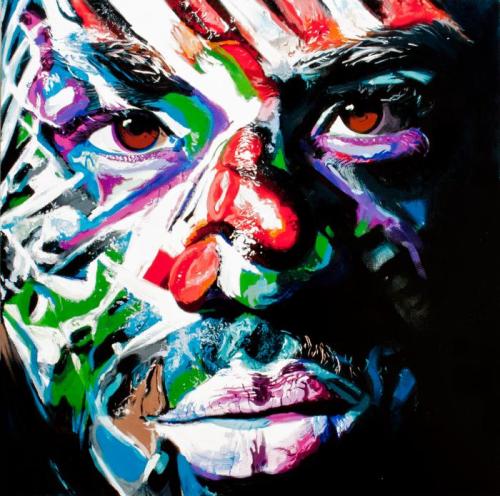
Artwork by Michael O 
(featured on www.hashthemag.tumblr.com)


Clay-eyed and metal-skinned executioners

breaking the body of the earth,


machinery rattling through the night,

workers aged by the wars of profit.


One man stands alone,

dreaming of an ending.


It’s happening, 

all around.

-Janelle Rainer
Janelle Rainer is a 24-year-old poet and community college teacher living in Colville, Washington. Her work has appeared in Harpur Palate, Steam Ticket, Script, Sugar Mule, and elsewhere. She earned an MFA in Poetry from Pacific University in Forest Grove, Oregon.​

Tuesday, 29 July 2014

We can’t be friends. We’ve been spoken for by the Universe, a power so knowing, so undeniable - it is beyond our combined scope. We can spend days by the ocean, skipping stones and flicking cigarettes but we know separation like we know regret; how inevitable it is, how looming it is.

The wind blows, a wave crashes and I turn to you, your body rich in color, irises the shade of emeralds, hair in a messy ponytail; a vibe so unfamiliar. I remember when I couldn’t look away.

“What do you think happens when we die?”

Sunlight hits your lens yet I can still see myself in the reflection, an orange tinge of a human being.

“Poof,” you say. “Nothing. You live and you die.” Your delicate fingers dance in the wind, hands intertwined above your head.

But that’s not true. You don’t believe that. We used to ditch parties and go to rooftops and stare at stars and point at the ones we’d like to come back as. I don’t faze you, you’ve grown too accustomed to these type of questions and musings.

“I feel sorry for you if you really think that,” I say and lay out, let the Sun scorch my skin, the beach towel the only thing between my bare back and specks of sand.

“Were you planning on doing something? You should do it soon.”

~

If I left it to you to explain, our story has no magic. It’s a moment. We met in a library, you needed a pencil, whatever. But when you hear me talk about the moment our eyes aligned, I can sense your awe, your sight following the words into the air, wishing you could gather this language and store it into a cauldron or a vase, decorate it with flowers, show it to your children. This fool fell for me one day. And he fell for me hard. Look how much he cared about me. Look at all the nice things he said about me.

“Our love is a facade,” you told me in privacy, two years later, cigarette in hand, eyes distant, cold, not there.

“A facade?”

“It’s not real. Nothing is real. We’re not here to do this, to live like this.”

“I love you.”

“How can you be so sure? What gives you the right to say something like that?”

“Just sit, let’s talk, can we talk?”

“I have to go.”

~

Why does the Woman cry? Why does the Man shout? If you leave, I’ll fall apart. I’ll disintegrate into the Earth, a lost memory, a facade of a human being, irrevocably ruined.

“I can’t do it anymore, I can’t take this shit.”

Your silhouette in the sun astonishes me. Its slender form, the way it moves, so smooth, so temporary. You know the type, the type of tears that sting to wipe away, to burn to release. If you leave, I’ll smoke a million cigarettes, drown in alcohol, call my mother, stare at space. We can’t be friends because we listened to Empathy together too many times in my backseat, in your bed, in my bed, in this lifetime. “I love you in a place where there’s no space or time.”

Sitting down next to me, your long fingers sifting through the sand, lighting a joint, I don’t think I could ever love again.

“This isn’t working. You’ve got to let me go, you’ve got to let me live.”

I could never be a surgeon. My hand trembles at your diction alone, my heart spirals into delusion. If you leave, I’ll go for a drive with the windows down, let the wind hit me. You always told me to remain unassuming, uncertain of the future. It’s a dice roll, a flip of a coin. It’s torturous. There's no year... just seasons.

"You need to love yourself first.”

I always knew it, I always knew love shouldn’t end in exhaustion, in repetition. If you leave, I won’t leave the house, tormented by what-ifs, goodbyes and no mores.

“If I leave, will you be okay?”

You don’t wait for an answer. You stand, your shadow towering over me, joint dangling from your fingertips and keep walking, seemingly into the Sun as it sets, a lone figure, a soul departed, a love unrequited. We can’t be friends because our love manifests itself into a ghost, a hazy dream, an illusion. As I go my way, the assumed truth slowly dawns on me: however long the heart beats, it has beaten both for and by you.

Mustafa Abubaker is a 21 year old writer and student of Pakistani descent in Atlanta, Georgia. A self-proclaimed music-addict, he wrote this story inspired by a Dream Koala song of the same name. 

He says, "This story is for me. I want to look back at it years from now and feel something."


Monday, 21 July 2014

What if you could step into the shoes of one of your most beloved icons at one of those crucial moments in their lives that end up defining them forever? Adam Ashraf braves these murky waters, venturing into the mind of the eternally fascinating Truman Capote on the eve of one such moment... 

My publisher just hand-delivered a copy of my new novel that will hit the racks next week- In Cold Blood, by Truman Capote. Me – cold-blooded killer. Merely looking at the instrument I used for the murder – the murder of a man far better than I – makes me nauseous. I can’t bring myself to touch it, much less read it. I steal a look at the back cover and read, “On November 15, 1959, in the small town of Holcomb, Kansas, four members of the Clutter family were savagely murdered by blasts from a shotgun held a few inches from their faces. There was no apparent motive for the crime, and there were almost no clues. As Truman Capote reconstructs the murder and the investigation that led to the capture, trial, and execution of the killers, he generates both mesmerizing suspense and astonishing empathy. In Cold Blood is a work that transcends its moment, yielding poignant insights into the nature of American violence.”

Truman Capote. My name always comes with a little bio. In early days, I was called “Local Reporter”. Later, it was “Freelance Writer for The New Yorker”. “Best-selling Author of Breakfast at Tiffany’s” followed. Today, I get a new sobriquet. It is the most significant of them all.

I wrote a book that was of a new genre; a new style of writing. It is bound to become a classic and is probably going to be compared to the work of Hemingway. I am probably going to be put in the league of Dickens, Twain and Fitzgerald. I’m not just about to become the Manhattan literary toast of the sixties, I am about to become an icon. As the dreariest of thoughts pops into my head, I pour myself a glass of champagne and toast, “To the man who betrayed his friend!”

“Was it all worth it?” I wonder. In forty years, what will the world remember? The man who betrayed his friend or the man who wrote the best non-fiction novel of his generation? Am I going to be compared to Hitler or Lincoln? After draining my glass down in a single gulp, attempting to vanquish the guilt that refuses to let me go, I pour another drink. “To the man who will inspire writers in generations to come”, I say as I wait for my emotions to numb.
(continued below)

“Of course it was worth it!” the rational side of me attempts to calm it down- the guilt.

“They were murderers, Truman.” I remember, my best friend, Nelle Harper Lee’s words from right after the execution. They are words that never fail to calm me down. “They were murderers, Truman”, I repeat to myself. Those words are my calming lullaby. They soothe me and shelter me from my own self-contempt. They help me sleep at night. I slump into slumber praying that they will sink in once and for all even though I know they never will. They are laws. They are not the spirit of the laws. They are what bound the laws, but they had nothing to do with justice. They are not what bound me. I know better. Perry Smith was indeed a murderer, but he was no beast. Perry Smith was indeed a murderer, but he was no monster. Smith was my friend. If Smith was a monster, then who is not?! If Smith was a monster, then what am I?! And now he is gone. The pen is mightier than the sword. I would know - I used it to kill.

That champagne isn’t serving its purpose. I need something stronger. I gulp a gin martini and toast out-loud with the theatrical tendencies I shall forever be notorious for, “TO THE MAN WHO KILLED HIS FRIEND”. I scream hoping it will numb my senses because the alcohol is doing such a bad job.

My demons will haunt me for life. I know that. I know that my editor, Shawn, is a stranger to the truth. He will lie to save himself the guilt. “You didn’t kill them,” he would tell me with the most plastic of smiles on his face. “You simply did not help.” Nothing is further from the truth. The whole jury probably read In Cold Blood’s excerpts before the final verdict was made and the sentence was uttered. I practically tied the noose around Smith’s neck with my bare, filthy hands, to land myself a bestseller. No, no, no – I did it to make myself an icon. I need more gin. Straight, this time.

“To the biggest writer of the twentieth century! TO THE BIGGEST FRAUD OF THE TWENTIETH CENTURY!” I toast in my sharp voice as I turn around flamboyantly.

What is happening to me? Why am I thinking like that? This is the book that millions around the world are waiting for! Millions around the world are chanting my name! I can’t pull the plug now. It’s too late. I’ll open a charity in Smith’s name. It’ll be redemption for his sins. “And yours too,” my demons remind me with a condescending look on their faces. I don’t know what they’re talking about – I haven’t done anything wrong. Everything will be okay. In one week, I’ll be the biggest household name in New York. I’ll be the biggest household name in America! I’ll attend all the fabulous galas and parties. Life will be good. It will be good. I’m sure it will be.

“It ought to be, right?” I mutter over another glass of gin.

-Adam Ashraf

Friday, 4 July 2014

Digital painting by Falk
Is this a common courtesy,
Alive in only me? 
Where once it was that thriving pulse in every vain, 
A common place, 
But with a societal pace, 
So easily did die away? 

Red, 
And rose, 
And chose- 
To leave a door unopened, 
A chair pulled in, 
A glass of wine replaced with rum, 
And beer, 
And sunsets of a fruity tinge? 

Or so did we whisk away- 
With a rude, 
Crude, 
Brute replace- 
Chivalry.

But try it for a taste, 
Give it your hand, 
For a kiss to place. 
You’ll find no kinder smile, 
Nor gentler pace. 

A suit, 
A tie, 
A poem- 
Confession? 
A lie… 

Oh but isn’t that the trouble, 
Let Chivalry that died rest,
It did so because- 
And this one must detest so- 
A fib, 
A phrase, 
A passing phase- 
I grieve, 
I weep, 
Because Chivalry did so, 
For Chivalry’s sake.

-Maurina Robinson
An aspiring Lead Game Designer, who captures dreams in writing as inspiration for that truly iconic, "terrifying" and artistic game that many will hopefully enjoy.

Read Maurina's "Butcher" in Issue 04 here.

Friday, 13 June 2014

I want to live with my parents forever because my passion does not bring the money for independence while mother chases away the beatniks because my lifestyle does not bring distinguishable satisfaction

I want to sleep on the floor of a ramshackle drug house, the rats biting my toes to wake me up and lice tap dancing in the forests of my head – a morning fix to add to the joy of working or living or bleeding as the pen quivers at the sight of my magical fingers

I want to curl up into a depressed ball of self loathing after reading rejection letters as my ex-sanguinated soul was not valuable or tainted enough to make money at the big summer sale

I want to be a burden for every friend I’ve ever made my drunken shenanigans remuneration for the never ending pile of favours that empties every wallet and coils around every mind like the shrewd boa of Eden

I want to contemplate suicide in the heartbroken shoes of eternal doomed romantics because my genius is left undiscovered for future generations to find and only then praise in my afterlife

I want to be the saintly nomad of the world – leaving pieces of his angelic heart in every village, fragments of his intellectual brain in every town and his dharma soul scattered throughout the rock

I want to embrace the radiantly malignant bosoms of life – losing myself in the love-struck snatches of the Aphrodite harpies, losing myself in the void of deliberate hallucinations, losing myself in the starry abyss of indie, psychedelic jazz and blues

I want to die too soon by the hand of god or my contradicting hand – my legacy is my life and its infinite struggles that enhance the eventual victories. Tears, blood and madness left behind for the miserable sheep that choose to follow and get high on tea and drunk in nightclubs and copulate ecstatically and write through tearful eyes then die at 27 and I am forgotten and they are reborn

I want to revolutionize the world with my essence – my artistic words to resurrect my heroic saviors and guarantee the sweet release of immortality.

- Gilroy Van Wyk
South African Mechanical-engineer-to-be-turned-wordsmith seeking self-enlightenment by embracing life, many religions, and every bit of knowledge this wonderful world has to offer.

Read Gilroy's 'Era of a Ruined Gods' in HASH E-zine Issue 04 here.


Wednesday, 4 June 2014

The enamel moon rises over the darkened land 
The stars sparkle like grains of sand 
The elusive stars flutter from our grasp 
Hanging just out of our begging clasp 
We remain grounded, covered in scars 
And shake our fists at the laughing stars 
We look up at the taunting sky 
And stand with an enduring sigh No matter how many times we tumble and fall 
We'll always dust off and stand up tall

-Sophia Randall


Thursday, 29 May 2014

Seasons change, night falls, day breaks, wealth fades, and technology ages but life is way more than that.

One cool summer night, I was gazing at the dark but starry heavens lit by the fullness of the moonlight when a scene caught and captivated my clouded senses. A scene that reminded me of what life on earth should be. A family in their barong-barong just meters away from where I am. A shelter made up of a recycled and rusted aluminium roof that, should an ant sneeze, would surely be blown off. Uneven wood flooring on which they spend their nights dreaming of their unrealized dreams and routine candle lit dinners. Sofas and toilets that flush shall forever remain a mystery to them. Their children go to school with faded and crumpled school uniforms, worn out bags, mismatched socks and- if they’re lucky enough- a good pair of shoes. Life was kept out of complexity. They don’t have televisions to spend watching dramas through the night; they don’t have Steve Jobs to reach the virtual world; they are strangers to Android; they don’t even have a bed to call their own. They don’t have Louis Vuitton or Hermes; they cook their food on firewood; they study their lessons through candle light, yet you can still see happiness and contentment in their eyes.

The scene made me feel light-hearted and realize how lucky I was to have parents working their butts off to send me to prestigious schools providing all the decent things I need. How lucky I was that when I was younger, I always had a new set of school supplies at the start of every school year. How lucky I was to own a Barbie when I was a kid, that I’m a computer literate at the age of 11, that I can goof around the club and eat on buffet anytime I want, that I am here writing this with an excellent power source.

Life is neither about wealth nor prestige, they are just merits. But real life? It is appreciating what you have and being happy despite of the detours, humps and road repairs during the journey. Learn to appreciate everything. If you are in pain, feel it! If you are confused, pray. If you are happy, scream at the top of your lungs, laugh your heart out, dance under the rain, and take chances. We’ve got only one life to live, dare to be different and make memorable memories.

-Julie Anne Damudara
Inspired, Inspirational, and dedicated, Julie Anne is a 20-year-old writer from the Philippines.


Artwork by Marta Dahlig

Monday, 31 March 2014


Eyes. Four letters. One meaning. The windows to our souls. Help us detect an unnoticed  lie and an obvious truth. Let us see light against dark. An advantage and a burden. One body part. Liberates right from wrong. Keeps us in place but can help us fall in depth. Controls our thinking and lets us escape reality. Eyes closed. Have our imaginations take over and leave the world behind. Another world. Eyes wide open. Lets us find out who we are. Why we choose to be the person we are today. A scary thought. A miracle. Eyes.

- Reza Moreno

Sunday, 9 February 2014

The dress was a shimmering shade of white; it puddled around her feet when she walked, making her far more beautiful than one could possibly imagine.

She was flawless and incredibly stunning, with the heavenly white dress to top it all off.

Living far above, she could but see the reflection of the image she had built in her head, of the world she had come to love so dearly.
This made her oblivious of the small details, the small imperfections that made the roots of her beloved world.

And so, one day, out of curiosity, she stepped out of her heavenly abode and for the first time, set foot into her much cherished world, flapping that brilliant dress behind her.

As she reached the gate, it opened before her, welcoming her with open arms, to prove to her that she had done well…or so she thought.
For once setting foot into the world, the light blue skies turned into a deep shade of grey and the green grass, burst into flames before her unbelieving eyes.

Hearing a loud tear, she found that the right strap of her dress was torn viciously.

And suddenly, she heard a crying scream. As she turned her head abruptly, she found herself – hoping against odds, it was a mere figment of her imagination – hurrying towards the sound.

Upon reaching the source of the sound, she could do nothing but stare in sheer despair.

She stood in a battle field, watching the massacre take place, unable to prevent it from happening.

People killing people, out of materiality, out of greed.
And with every tear shed, every drop of innocent blood spilled, her dress became scarred. Piece by piece, the elegant white dress, turned red – the color of brutality, of inhumanity - , the soft fabrics, of which the dress was made, were mangled beyond recognition.

And as the white dove was shot out of the sky, heartlessly, and without even the smallest hint of hesitation, she fell on the ground.
Holding, what was left of the once flawless, one-of-a-kind dress to cover herself up, she put a hand on her heart, trying her best to put an end to the pain she felt, the disappointment in the inhabitants of her beloved world.
Looking at the dove, now lying on the floor, eyes still and resembling crystals, she lay on the floor beside it.

The world had lost so much, in that moment, for the heart of the earth, was bleeding.

And one is faced with a perplexing question: Will she be left to bleed, or will she be saved miraculously, by the same people who had inflicted the wounds on her?

-Layan Adham Ismail
Self-proclaimed 'writer wannabe', 'drama queen', 'annoying know-it-all', 'avid exaggerator'. The makings of a creative megamind.


Watercolor painting by Agnes Cicile

Previously published in TeenStuff Magazine, Egypt.

Friday, 24 January 2014

                          
                                                       Hashthemag- Tumblr

I was lying on the roof top one evening, staring at the glowing sky. I was mesmerized by the twinkling stars, how they are so far away yet you can still see their beauty. Then the weirdest thought occurred to me... What am I really bedazzled by? Travelling light?

I say I'm looking at stars, but I'm actually staring at the trace they left behind. It was an illusion.

It reminded me of the people who walk in then walk out of our lives every day. They always leave something behind, something to remember them by. Good memories. Bad memories. Their belongings. Maybe even things they "accidently" left behind.

I think of how they appear to be one person the moment they walk into our lives... how we bond, build trust, create a foundation for the relationship to be built upon... and then think of the person they are when they walk out. You get that feeling that the person walking out that door is a complete stranger.

I remember personally thinking... How could I have not known that he or she would turn out to be like this? How could I have been so blind? How could I have not seen this coming? How could I be so foolish?

I was living an illusion.

Then like everybody else I sit and I mourn, I scream and I yell, I curse and I cry, sooner or later... I move on.

Five years down the line, I meet someone, I become part of his life, we become good friends for three years... maybe even more than friends. And the moment I was in arm's reach of something better, something I thought to be "valuable" at the time, I walk right out of his life and go on like he never existed.

I get a flashback of the person who was very important to me and walked out of my life. And the reality of what I was doing was like a slap in the face.

The person who I walked out on, who was suffering because of me didn't deserve the pain I caused him. And for what... for genuinely caring about me? Who was I to do such a thing?

And, ironically, I followed back the trace I created.

Its so easy for us to walk over each other to get to where we want. But wouldn't it be much easier for us to just let them tag along the journey of success with us?

Shakespeare, brownies and warm milk is my kind of cocktail.

Tuesday, 7 January 2014

Lion in a coma, lion in a coma
Who wants to smell the fine aroma
Animal Collective


I want to smell the fine aroma

The fine aroma of Leila’s leisurely cigarettes
Not the way she smokes now.
The revolting scent of a hated habit, yearn for most.

As her homeland crumbles, Dunhill Switch to Captain Black she wishes to relax

Yet her pulmonary veins continue to throb, cinnamon sears with every pulse
Destroying her lungs the way the Lions have destroyed everything
Everything.

From her sister’s voice box, bedridden not only by a critical error but by years of rooted terror

That not only choke the throats of my paralyzed Teta but the throats of every Syrian woman, man, child.

“Don’t talk about such things on the phone ya Asma’a”

Don’t talk.
Rip your throat box out before the calamity of the consequences of free speech impend on you
Like they impended on your father
Like they impended on your mother

How can they not see?

You cannot impend upon bravery.
How can you not see?
The Lions will not destroy their bravery.

Mount Vesuvius is no longer dormant

Ashes of withering sorrow knotted in our knuckles
Pompeii hunters seek the informant.
Pointed bullets to the Lion’s den, bullet through his head,

Silence the chuckles.

Lion in a coma, lion in a coma
Freedom is my fine aroma

-Asma Alabed

Tuesday, 24 December 2013

Equivalence was dear to me,

It was a yearning of the soul.

Two equal halves, a balanced mind,

It took its toll.


With the hand's slightest twitch,

The colors start to blend.

Perfection dies before your eyes,

and symmetry is at an end.

-Joshua White
An Airman with an imagination